

Collaboration to Increase Contribution to the Klaten-Sleman Region through Management of the Prambanan Temple Destination
PT Taman Wisata Candi Borobudur, Prambanan and Ratu Boko (Persero) together with the Sleman Regency Government and the Klaten Regency Government agreed on cooperation to increase the contribution of the Klaten-Sleman region through the management of the Prambanan Temple Destination.
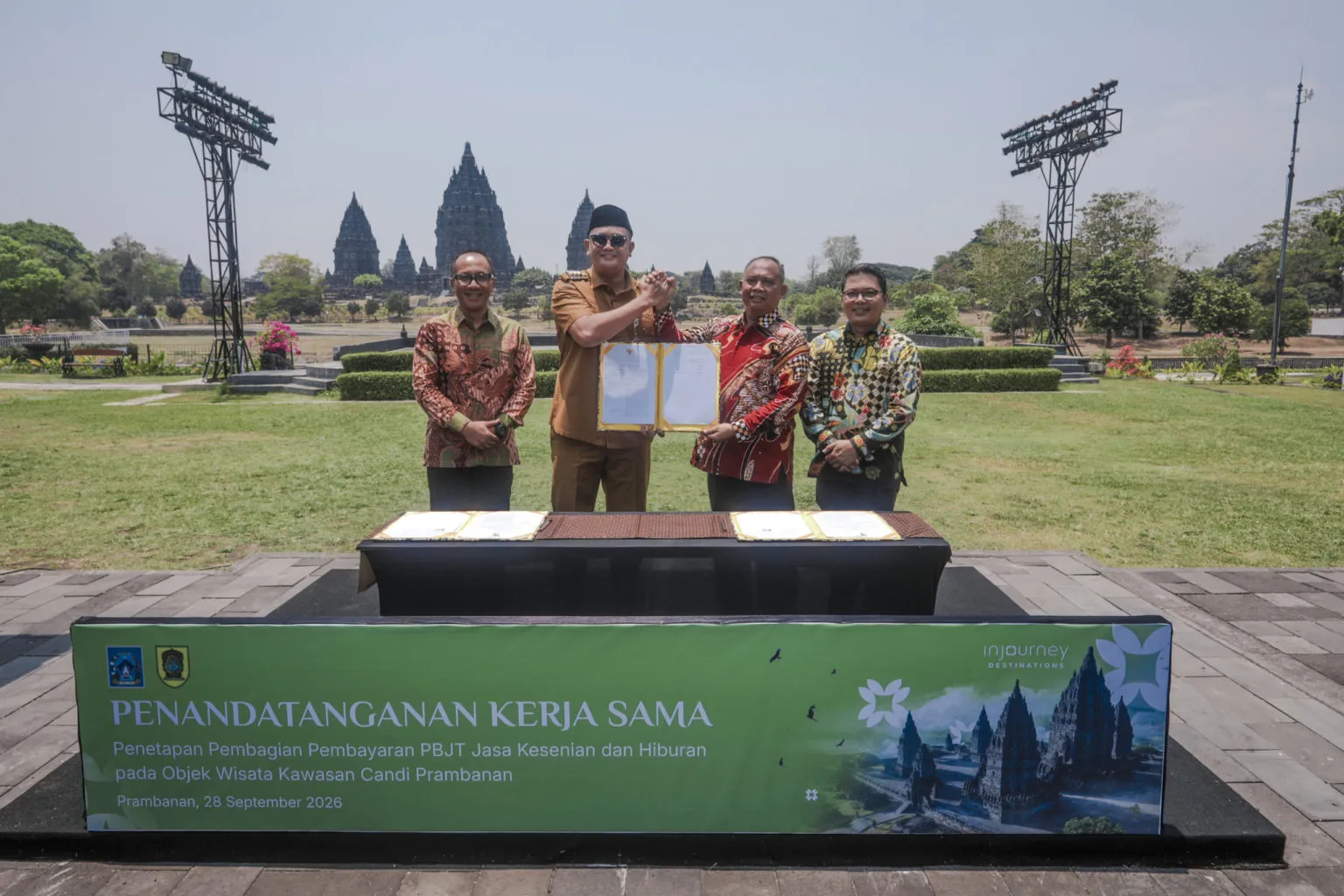
This was emphasized through the signing of a Cooperation Agreement on the Determination of Payment Distribution for Certain Goods and Services Tax (PBJT) for Arts & Entertainment Services at the Prambanan Temple Tourist Attraction at Rama Shinta Garden Resto, Prambanan, Sleman, on Monday (September 28, 2026). This is part of an effort to strengthen coordination between area managers, local governments, and stakeholders around Prambanan Temple.
PT TWC's Director of Finance and Risk Management, Joel Siahaan, said that the cooperation in determining the distribution of PBJT payments is one concrete form of this collaboration.
"After some time has passed, we will sign a cooperation agreement to determine the distribution of PBJT payments for arts and entertainment services at the Prambanan Temple tourist attraction," said Joel.
PBJT is a tax related to the consumption of certain goods and services. In the context of this collaboration, the object of discussion is arts and entertainment services within tourism activities in the Prambanan Temple area. This collaboration also forms part of the Prambanan area's governance, involving corporate interests, local governments, and the community.
Sleman Regent Harda Kiswaya emphasized that the benefits arising from tourism activities in Prambanan need to be supported through collaborative environmental and area management.
According to him, Sleman and Klaten Regencies each have a role to play in ensuring the environment around Prambanan supports tourist comfort. Everything from environmental cleanliness and river management to the development of supporting facilities requires collaboration.
"Let's support each region so that tourists can relax in Prambanan," said Harda.
He also hopes that tax revenues that are part of the regional government can be utilized optimally to provide benefits to the community.
"With a strong commitment, God willing, the people of Klaten and Sleman will truly feel the benefits. Because what they're waiting for are our policies as the local government," he said.
Klaten Regent Hamenang Wajar Ismoyo said that the collaboration fostered a sense of rumangsa melu handarbeni or a feeling of joint ownership and care for Prambanan Temple.
"Hopefully, this will be a good start, so we can all feel a sense of shared ownership of Prambanan Temple. As the Javanese say, rumangsa melu handarbeni (working together to care for and develop Prambanan Temple)," Hamenang explained.
Klaten Regent Hamenang Wajar Ismoyo stated that Klaten Regency has continued to develop its tourism potential in recent years. Prambanan Temple is also considered to have significant potential to become a driving force for regional tourism development.
"In the future, with this collaboration, Prambanan Temple will, God willing, become a major tourist attraction. We will collaborate on events at both the national and international levels to further Prambanan's development," he said.
PT TWC is committed to providing a positive impact on the growth of the Sleman and Klaten regions through various environmental social responsibility programs, such as the construction of habitable houses and various other social programs.
On the service side, PT TWC also runs the InJourney Hospitality House program to improve the understanding and hospitality skills of people who are directly or indirectly involved in tourism services.
"The goal is for us to work together to serve all visitors with the best hospitality so that everyone has an extraordinary experience," said Joel Siahaan.
Cooperation in determining the distribution of PBJT payments is an instrument for regional governments to become a source of regional income in accordance with the provisions of laws and regulations.
However, all parties emphasized that the benefits of Prambanan Temple extend beyond attracting or increasing tourist visits. The development of the area must also have broader social and economic impacts on the surrounding community.
"We can preserve Prambanan Temple, a legacy left by our ancestors, together. We can develop it so that we don't just seek its sustenance, but also continue to ensure that Prambanan Temple can continue to be enjoyed by our children and grandchildren, future generations," said Hamenang.
Through this agenda, PT TWC, along with the Sleman and Klaten Regency governments, is committed to continuing its collaboration in the management and development of the Prambanan area. This collaboration is expected to maintain a balance between cultural heritage preservation, tourism development, governance, and community economic growth.
"We hope that with this good cooperation going forward, we can perform better as a corporation, not only in terms of our performance as a corporation but also in terms of our impact on the surrounding community through economic and social impacts," concluded Joel Siahaan.