

The Unfinished Buddha: A Mysterious, Incomplete Statue
List of contents:
- Unfinished Buddha, the Mystery Behind Unfinished Statues in Borobudur Temple
- Who Found these Mysterious Statues?
- Who Are the Figures Depicted in the Statues?
- Opinions Among Experts
- Activation of the Unfinished Buddha during the Holiday Season
- Exploring the Mysterious “Unfinished Buddha” in Borobudur Temple
Borobudur Temple Compounds, the largest Buddhist architectural masterpiece and one of the UNESCO World Heritage Sites, was thought to have been lost for centuries before being rediscovered in 1814 by Sir Thomas Stamford Raffles.
After going through a series of gradual restoration processes since the Dutch East Indies era, Borobudur Temple still leaves mysterious historical traces with the discovery of the "Unfinished Buddha" statue.
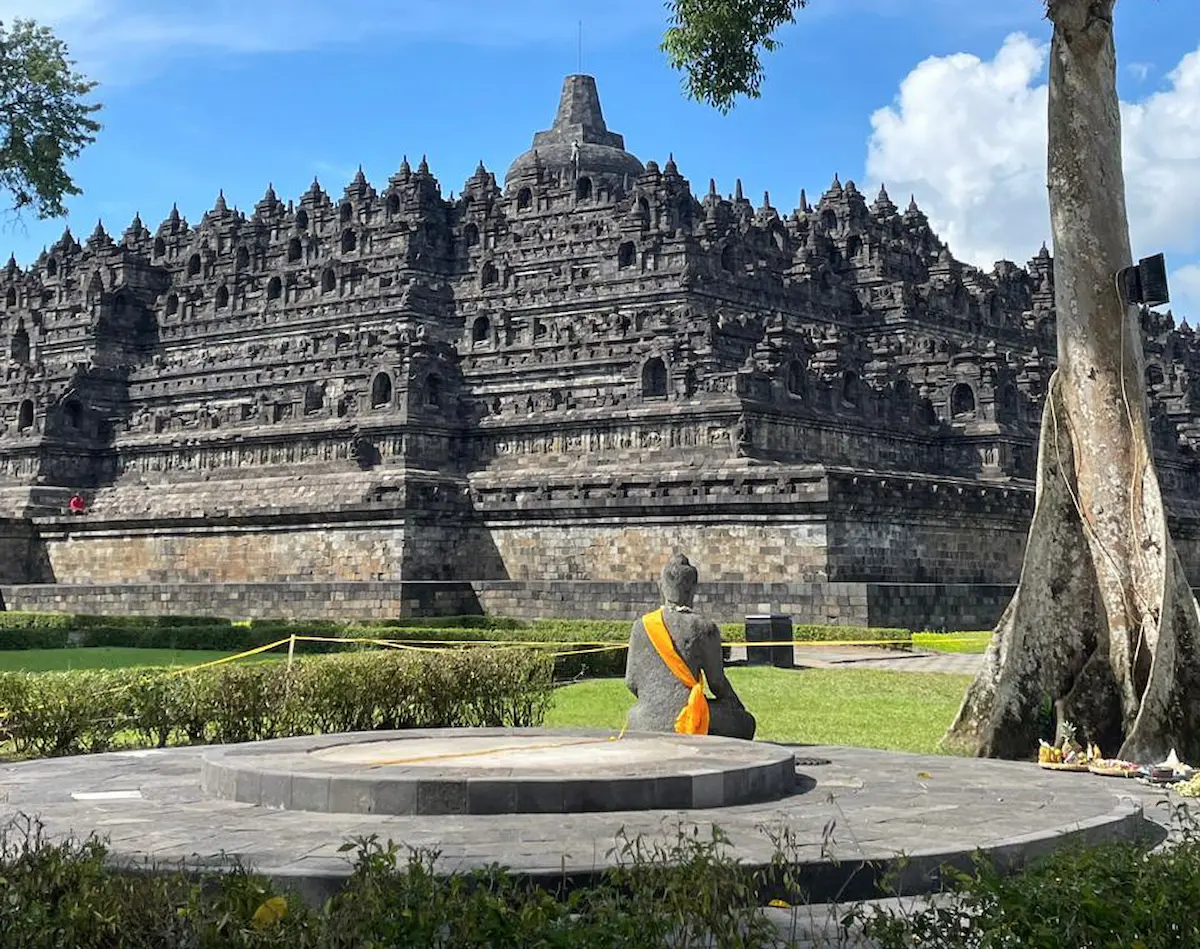
The Unfinished Buddha is one of the attractions in the Borobudur temple complex and is always housed in the Karmawibhangga museum. After a while, the statue was moved to the Borobudur temple yard, allowing visitors to pay a visit. Discover more information related to Unfinished Buddha below.
Unfinished Buddha, the Mystery Behind Unfinished Statues in Borobudur Temple
The Unfinished Buddha is a term coined by archaeologists for a Dhyani Buddha statue whose construction was suspected to be unfinished. Among the surrounding residents, this statue is known as “Mbah Belet”.
On a closer look, several parts of the statue, such as the hand, leg, and body, are not perfectly carved. In addition, there are damaged or missing parts, especially on the forehead and face. It may be due to the lower quality of the materials used to carve the statue compared with other statues at Borobudur Temple. This statue is made of andesite, consisting of many pores and textures that are not solid, thereby making it of lesser quality.
Given its size, the Unfinished Buddha also does not fully adhere to the Uttam Das Hatala, the proportion rules generally observed in Buddha statues carved in that particular era. This is why the Unfinished Buddha is one of the unique and mysterious heritage objects in the Borobudur temple area.
Who Found these Mysterious Statues?
The Unfinished Buddha was first found during the Borobudur temple reconstruction phase in Theodoor Van Erp’s era between 1907–1911. At the time, the Dutch East Indies government instructed the statue to be moved to the temple’s yard based on N.J. Krom and D.D.K Bosch’s consideration.
These are magnified by the absence of this statue’s record in The History of Java written by Thomas Stamford Raffles in 1817. However, another note written by F.C Wilsen in 1849–1853 during the creation of Borobudur relief panels showed that there was indeed an unfinished carving of a Buddha statue in the main stupa.
However, looking further back, the note on the Unfinished Buddha statue was also recorded in Serat Centhini, which was initiated by Kanjeng Gusti Pangeran Adipati Anom Amangkurat III in 1820. This serat (letter) strengthened the proof that the initial location of the Unfinished Buddha was on the upper parts of the Borobudur temple.
Who Are the Figures Depicted in the Statues?
A Dutch researcher and archeologist, W.F. Stutterheim, believed that the Unfinished Buddha statue is Bhatara Buddha. This is sourced from the Ancient Javanese Book Sang Hyang Kamahayanikan.
According to Stutterheim, there are 505 statues in Borobudur Temple. However, there are currently only 504, so one statue is missing. Hence, Stutterheim concluded that the unfinished Buddha statue is Bhatara Buddha.
Opinions Among Experts
Since old times, the originality and meaning of the Unfinished Buddha have been a topic of debate. The unique property of this statue even sparked various opinions from experts:
- Hartman (1842), a Dutch administrator stationed in Kedu, said that the statue most likely originated from the main stupa.
- Govinda (1976) said that the statue represented Adi-Buddha, which appeared from sunyata in a way similar to that of Adi Buddha Vajradhara, located on top of Gyantsesku'bum. Gyantsesku'bum.
- Soekmono (1976) offered a different opinion, arguing that the statue cannot represent Adi-Buddha or the Buddha in the highest condition due to its unfinished features. Hence, he said that the statue cannot be placed inside the main stupa if we are to adhere to its original concept.
- Gangchen and Gyatso (1993) where these experts agreed with Soekmono. Gangchen stated that the statue in the main stupa is mostly made of gold and was stolen long ago.
In addition, several texts and manuscripts contained in Bstan-'gyur about how to fill in a Stupa also stated that only pictures and high-quality materials are allowed to be placed inside the Stupa.
Activation of the Unfinished Buddha during the Holiday Season
The mystery and unique features of the Unfinished Buddha have sparked debate among experts, but it is also an attraction for visitors to the Borobudur temple.
Based on these facts, the statue, previously housed in the Karmawibhangga Museum, has been moved to the Borobudur temple yard, specifically to the Kenari yard in the western part of the temple. This is an attempt by the government to recognize and support the preservation of local traditions and cultural values.
To this day, residents of Borobudur Temple and surrounding areas still pay respects to the Unfinished Buddha statue as a symbol of spirituality and positive energy across various aspects of society.
Interestingly, during the school holiday season, from 20 June to 20 July 2026, the Temple Tourist Spot activates the Unfinished Buddha statue. During this activation period, you can visit the site where Mbah Belet is located in Kenari Park and offer night-blooming jasmine flowers.
This is intended so that visitors can enjoy a more meaningful experience and appreciate the historical significance and philosophical feat of the Unfinished Buddha directly.
Exploring the Mysterious “Unfinished Buddha” in Borobudur Temple
After reading the short history of the Unfinished Buddha, are you interested in visiting and seeing the mystery and unique story behind this statue on site?
So, don't miss out, as this activation only lasts until July 20, 2026. Secure your tickets to Borobudur Temple now by purchasing them online through the official InJourney Destination website . You can choose between the Temple Courtyard or Temple Climbing tickets , depending on your vacation plans.
You can also book tickets online or at the ticket counters in Borobudur Art Village. See you!